Breaking the strongest bond in the air
Nitrogen fertiliser is made by pulling nitrogen out of the atmosphere and turning it into something a plant can absorb. The chemistry is well understood. What is hard — and what Harvora is building — is doing it at the size of a farm rather than the size of a factory.
The Harvora process
The Submerged Bubble-Arc Corona Reactor
Most plasma fixation runs the discharge through open air, then has to capture the reactive gas afterwards and dissolve it into water — a second stage, with losses at each step. Harvora runs the discharge underwater instead. Air is bubbled through a submerged electrode gap, and a combined arc and corona discharge fires inside those bubbles, at the boundary between gas and liquid.
Because the reaction happens inside the water, nitrate dissolves the moment it forms. There is no separate absorption stage and no reactive gas to handle — what leaves the reactor is already nitrate solution, ready to irrigate with.
01 — Air in
Nitrogen is everywhere, and locked
Air is about 78% nitrogen. Every molecule is two nitrogen atoms held together by a triple bond — one of the strongest bonds in chemistry. Plants cannot use it in this form.
Nitrogen is everywhere, and locked. Air is about 78% nitrogen. Every molecule is two nitrogen atoms held together by a triple bond — one of the strongest bonds in chemistry. Plants cannot use it in this form.
Why nitrogen is hard to unlock
A nitrogen molecule is two atoms bound by three shared pairs of electrons. That triple bond takes roughly 941 kJ/mol to break — among the strongest bonds in nature. It is the reason the atmosphere is 78% nitrogen and almost none of it is available to crops.
Nature solves this with bacteria, slowly. Industry solves it with the Haber-Bosch process, which forces nitrogen and hydrogen together under extreme heat and pressure. Haber-Bosch works — it feeds a large share of the world — but it only makes economic sense at enormous scale, which is why fertiliser is made in a few places and shipped everywhere else.
A plasma discharge takes a different route. Rather than heating and compressing the gas, it accelerates electrons to energies high enough to break the bond on impact. That shifts the problem from one of pressure vessels to one of electricity — and electricity is something a farm can have.
The same chemistry, at very different scales
Both approaches end with usable nitrogen. What differs is what each one demands of the infrastructure around it.
The industrial standard since 1913
Haber-Bosch
- Needs 400–500°C and several hundred atmospheres of pressure
- Requires a hydrogen feedstock, usually from natural gas
- Only economic at very large scale, so production is centralised
- Roughly 10–12 kWh per kg of nitrogen, after a century of optimisation
- Output has to be shipped, trucked, and distributed to reach a farm
Harvora's approach
Plasma fixation
- Runs at ambient pressure, driven by an electrical discharge
- Feedstock is air and water — no hydrogen supply chain
- Works at small scale, so a single farm is a viable unit
- 2,100–3,200 kWh/kg N on the current MVP — the gap this programme exists to close
- Produced at the point of use, so there is nothing to ship
Plasma nitrogen fixation is not a new idea — an arc-based version, the Birkeland-Eyde process, ran commercially in Norway from 1905 before Haber-Bosch displaced it on efficiency. The chemistry has never been in question. What has changed is the cost of electricity, the availability of solar generation, and the engineering needed to make a small unit practical.
One process, two deployments
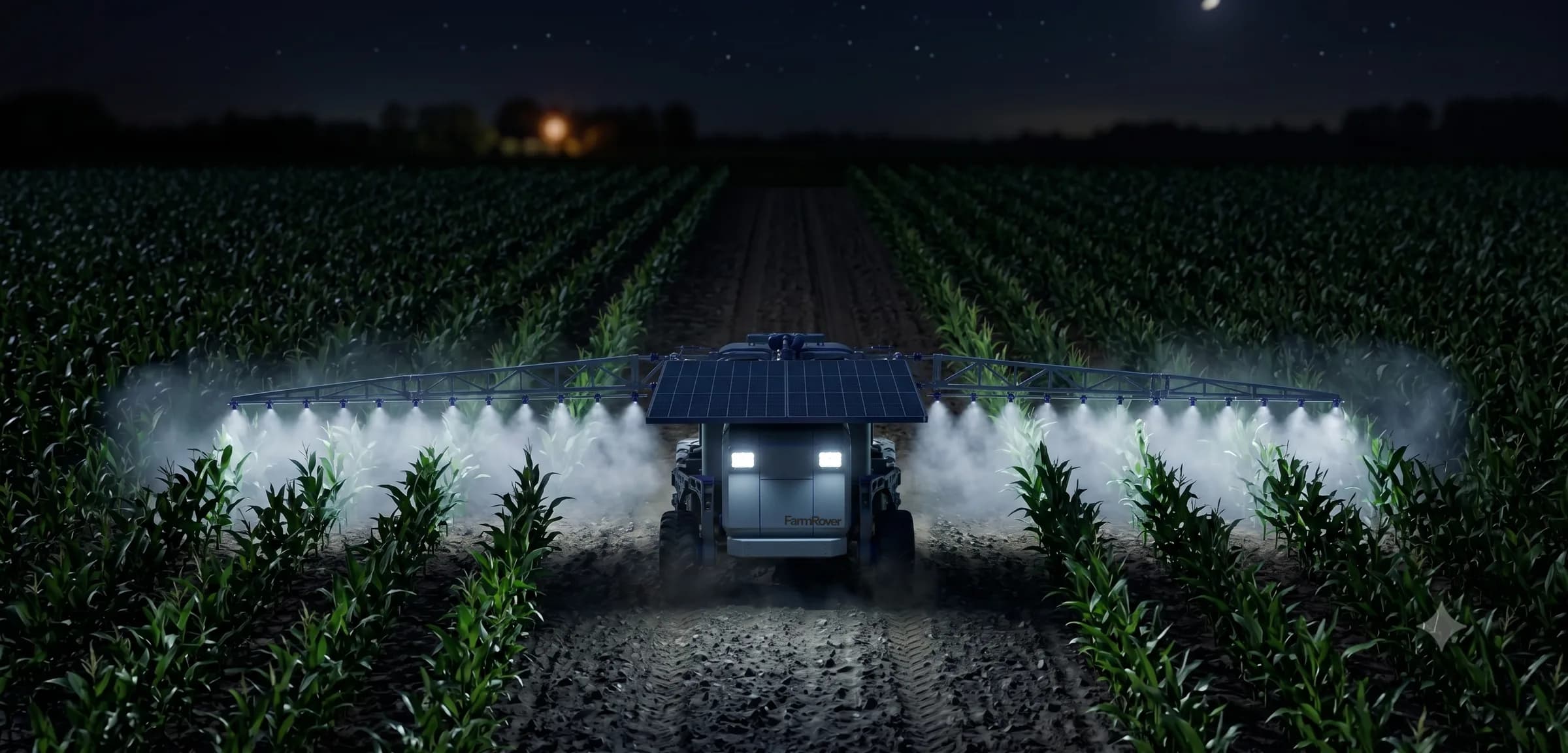
The same Submerged Bubble-Arc Corona Reactor sits inside both products. FarmRover carries it to the crop; NitroFab keeps it fixed alongside a greenhouse and feeds existing irrigation.
Current MVP output
What the machine does today
These are Harvora's own measurements of the V0 prototype, not a product specification. At this output a single unit supplies a small fraction of one hectare's seasonal nitrogen requirement — the machine demonstrates the process, it does not yet feed a farm. Raising concentration and throughput is the same engineering problem as raising efficiency, and the same programme addresses both.
- Production rate
- 150 L
- solution per hour
- Concentration
- 12–18
- ppm NO₃⁻
- Power draw
- 1.3 kW
- reactor only, rover idle
MVP measurement — not a product specification
Where this is not good enough yet
Plasma fixation lives or dies on one number: the electricity required to fix a kilogram of nitrogen. Ours is not yet low enough, and we would rather you read that here than work it out yourself.
The best run measured at KNUST — 500 W for five minutes — works out at approximately 4,754 kWh per kilogram of fixed nitrogen. To compete with imported urea on a Ghanaian farm, that figure needs to reach roughly 20 to 50 kWh/kg N. The gap is about two orders of magnitude, and closing it is the entirety of Harvora's current engineering programme.
Efficiency also degrades as the reactor is pushed harder. Higher power and longer runs produce more concentrated nitrate but consume disproportionately more energy per kilogram fixed. That points at the boundary between gas and liquid rather than at the discharge itself, and it is where the work is going: electrode geometry, arc shaping, and mass transfer inside the bubble.
There are two numbers here, and they do not agree. The 4,754 figure is the best of three timed laboratory runs. The FarmRover MVP's own output — 150 L/h at 12–18 ppm NO₃⁻ on a 1.3 kW draw, reactor only with the rover idle — works out at 2,100–3,200 kWh/kg N, so the integrated machine is currently more efficient than the best bench run. We quote the higher, more conservative figure in funding applications and at the top of this page. Anyone checking the arithmetic finds the lower one, so both are here.
For scale: industrial Haber-Bosch synthesis runs at roughly 10–12 kWh/kg N. It is among the most optimised chemical processes in existence and it took a century of engineering to get there. Harvora does not expect to beat it on energy, and the case for on-site production was never that it would. A farm that cannot reliably buy urea is not choosing between two efficiencies. It is choosing between nitrogen and none.
We publish this because it is the first question any serious evaluator asks, and because a reactor already cheaper than urea would not need a page explaining itself.
- Laboratory run
- ~4,754 kWh/kg N
- 500 W, 5 min — best of three KNUST-verified runs
- FarmRover MVP
- 2,100–3,200 kWh/kg N
- implied by 150 L/h at 12–18 ppm on 1.3 kW, reactor only
- Field-viable target
- 20–50 kWh/kg N
- what beats imported urea
- Status
- Funded engineering milestone
- current development programme